Nobody at Your Firm Really Knows Where You Stand on Security. Here's Why That's the Norm — and How to Fix It.
Ask a partner to describe their firm's cybersecurity posture and you'll get a confident non-answer or an honest shrug. Neither is a knock. Here's why law firms are stuck in this position, and the Guardian workflow that closes the gap.

The Two Answers Every Partner Gives
Ask a partner at a mid-size firm to describe the firm's cybersecurity posture, and you'll usually get one of two answers: a confident non-answer ("IT handles that"), or an honest shrug.
Neither one is a knock on the partner. Law school doesn't teach encryption standards, and running a practice doesn't leave much room to become a security officer on the side.
The problem is that law firms are sitting on exactly the kind of information attackers want most: privileged communications, financial records, M&A details, litigation strategy, client PII. Firms are targets precisely because they hold everyone else's secrets — and most have no one on staff whose actual job is to track the fundamentals.
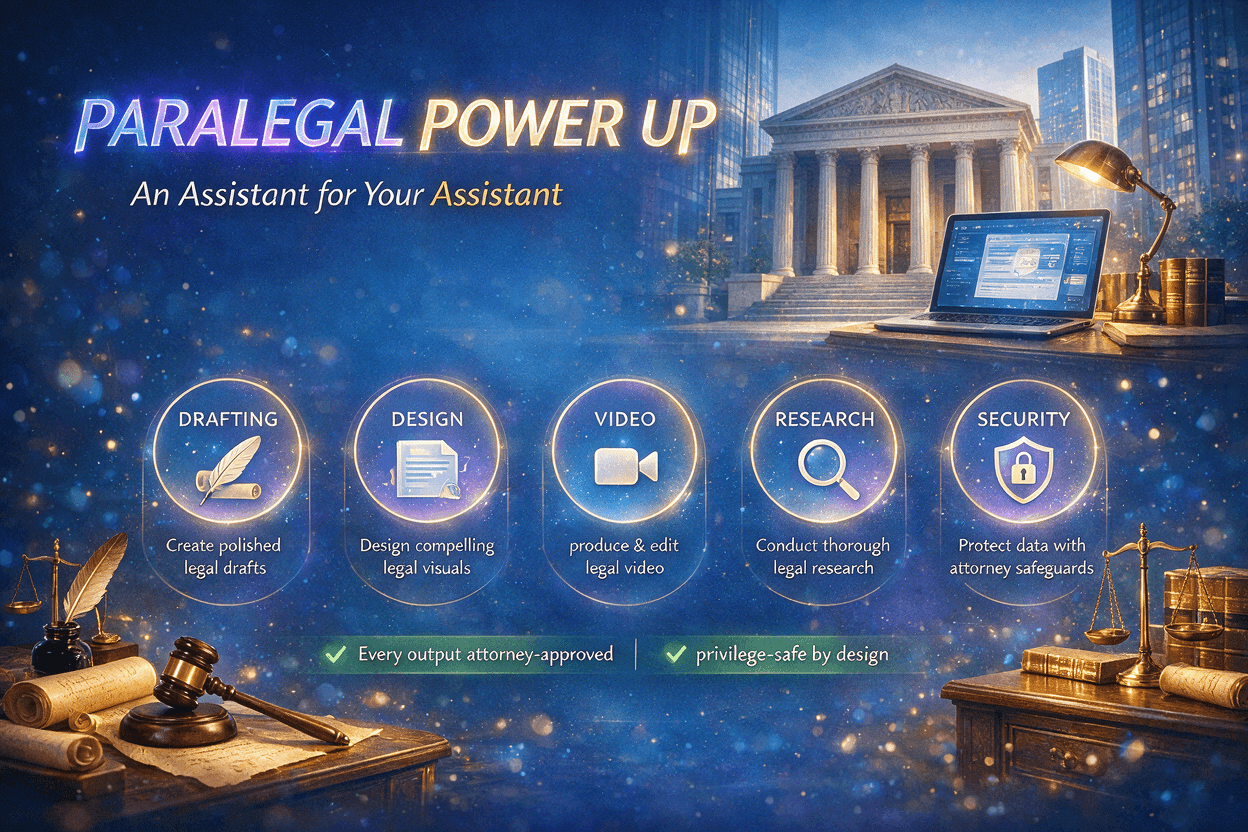
That gap is what The Guardian, part of the Paralegal Power Up bench, is built to close.

A Security Posture Score You Can Actually Explain to a Partner
Instead of a vague sense that "we're probably fine," The Guardian runs a live checklist across the fundamentals — MFA, encryption, backups, staff training, vendor terms, AI usage policy — and rolls it into one score.
It's the difference between "I think we're okay" and "we're at 67, here are the three quick wins that get us higher this month." That's a number a managing partner can put in a memo, and a number a paralegal can actually act on without needing a security background.
The score updates as your posture changes. Enable MFA on the last holdout account, it moves. Ship a vendor termination for a partner you're no longer working with, it moves. Onboard a new staff member and finish their training module, it moves. Security stops being a snapshot and starts being a real-time signal.
A Threat Brief Written for Law Firms, Not IT Departments
Generic cybersecurity news doesn't tell you what's actually hitting firms this week.
The Guardian's threat brief does — ransomware campaigns targeting mid-market firms, wire-fraud schemes hitting real estate closings, e-filing portal scams, vendor breaches that quietly expose client data — each paired with the one concrete thing to do about it. No jargon, no forty-page whitepaper. Just: here's what's live right now, and here's your move.
The Part Everyone's Guessing About Right Now: AI
Every firm is using AI in some form already, whether that's sanctioned or not. Almost none have a written policy governing it, and most partners couldn't tell you what the "AI-specific rules most people get wrong" actually are.
The Guardian bakes plain-language guidance for the AI era directly into the security checklist, so "do we have an AI policy" stops being a question nobody can answer. This mirrors the governance principles we cover in AI ethics for lawyers: Rules 1.1, 1.6, and 5.3 and the state bar AI opinions that keep landing every quarter — but instead of a PDF policy that gathers dust, it's a checklist that gets acted on.
For firms already using our Legal Prompt Ops Console, The Guardian is the security-side counterpart: prompt ops governs how AI produces work, the Guardian governs how the firm handles the security posture around it.
Guardrails Before Anything Goes Out the Door
Before a document leaves the firm, The Guardian scans it for privileged content and client PII — the kind of thing a tired associate misses at 11pm before a filing deadline.
And if the worst does happen, it drafts a first-pass breach notice against your state's specific notification clock, so the firm isn't starting that document from zero while the clock is already running. That's the difference between a controlled disclosure and a scrambled one.
The Bigger Point
Security at most firms isn't a strategy — it's whoever remembered to ask IT a question six months ago.
The Guardian doesn't try to turn your paralegal into a CISO. It gives them a specialist to direct, the same way The Drafter and The Studio do, with an attorney still reviewing anything that goes to a client. The firm gets an actual, current picture of where it stands — not a guess.
This fits the broader pattern we recommend across every AI Operating System engagement: never let AI operate without an audit trail, never let output go client-facing without attorney review, and always know what your posture looks like on any given day. The Guardian is the security-facing implementation of exactly those principles.
Where to Start
If "where do we stand on security" isn't a question your firm can answer today, that's usually the clearest sign it's worth a look.
Try Paralegal Power Up → — the pilot spins up The Guardian alongside The Drafter, The Studio, and The Toolkit, and a paralegal can start running the checklist against your firm within a week. Or book a 30-minute call if you'd rather walk through what a Guardian-first rollout would look like for your specific setup.
The firms that answer "where do we stand on security" with a number are already ahead of the ones that don't. That gap is only going to widen.

Christopher Costa
Founder of Legal Search Marketing, helping law firms transform their practice with AI. Expert in GEO optimization, AI implementation, and legal technology strategy.
Ready to Implement AI at Your Firm?
Schedule a discovery call to discuss how AI can transform your practice.
Schedule Discovery Call